

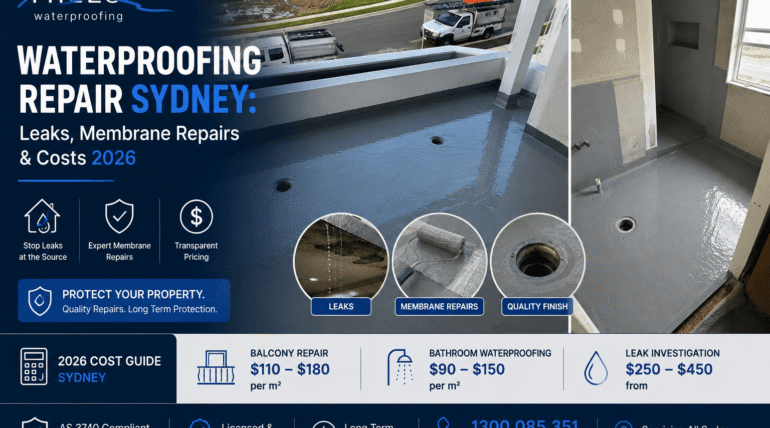
Waterproofing Repair Sydney: Leaks, Membrane Repairs & Costs 2026
Last Updated: Septemeber 2026
Short Answer:
Waterproofing Repair Sydney
Waterproofing repairs in Sydney can range from minor localised repairs to complete membrane replacement, depending on the source and extent of the leak. Common causes include failed waterproofing membranes, poor drainage, cracked substrates, defective junctions, ageing waterproofing and incorrect installation. Persistent leaks, mould, damp walls, ceiling stains and bubbling paint should be investigated before surface repairs are attempted. If the waterproofing membrane itself has failed, access beneath tiles or other finishes may be necessary to provide a long-term repair.
Key points:
- Not every waterproofing leak requires complete replacement.
- Regrouting alone will not repair a failed membrane.
- Bathrooms and balconies are two common sources of waterproofing failure.
- Finding the source of the leak should happen before demolition.
- Early repairs can help prevent larger rectification costs.
- Professional inspection is especially important when leaks keep returning.
A waterproofing problem rarely begins with a major flood.
It normally starts with something small.
A stain on the ceiling.
A damp smell beside the bathroom.
Paint bubbling near a balcony door.
Mould returning after heavy rain.
Or water appearing in a room underneath a bathroom or balcony.
By the time these symptoms become visible, moisture may already be travelling underneath tiles, through screeds, behind walls or into the building structure.
If you’re looking for waterproofing repair in Sydney, the most important step isn’t immediately replacing tiles or applying another sealant.
It’s finding out why the waterproofing is failing in the first place.
At Hills Waterproofing, we help Sydney homeowners, builders, strata properties and property managers investigate waterproofing problems and determine the appropriate repair.
Do You Need Waterproofing Repair?
Some waterproofing problems are obvious.
Others remain hidden for months.
Common signs that you should investigate your waterproofing include:
- water stains on walls or ceilings
- mould that keeps returning
- musty or damp smells
- peeling or bubbling paint
- loose tiles
- cracked grout
- swollen skirting boards
- efflorescence
- water entering after rain
- moisture below a balcony
- leaking showers
- dampness in rooms beside a bathroom
These symptoms don’t necessarily prove that the membrane has failed, but they are strong reasons to investigate the source.
What Causes Waterproofing to Fail?
There are many reasons a waterproofing system can develop problems.
Failed Waterproofing Membrane
The membrane is one of the most important parts of a waterproofing system.
Because it is usually concealed beneath tiles or other finishes, membrane failure may not be visible until water damage appears elsewhere.
Possible causes include:
- ageing
- inadequate application
- poor adhesion
- movement
- incompatible materials
- damage during construction
Our detailed Waterproofing Membrane Sydney guide explains membrane systems in greater detail.
Poor Waterproofing Installation
Even high-quality waterproofing products can fail if they’re installed incorrectly.
Problems can occur when:
- surfaces are poorly prepared
- the membrane is applied incorrectly
- curing times aren’t followed
- junctions aren’t properly detailed
- penetrations aren’t treated correctly
This is one reason choosing an experienced waterproofing contractor matters.
Poor Drainage
A waterproofing membrane isn’t designed to compensate indefinitely for inadequate drainage.
Balconies and other external areas can develop problems when:
- falls are incorrect
- outlets become blocked
- water ponds
- overflow provisions are inadequate
Hills Waterproofing already has a detailed guide covering Balcony Drainage Regulations NSW, which is one of the strongest-performing resources on our website.
Building Movement
Buildings naturally move.
Expansion, contraction and settlement can affect:
- corners
- joints
- tiled surfaces
- membranes
- balcony junctions
Movement-related cracks can eventually create pathways for moisture.
Failed Bathroom Waterproofing
Bathrooms are another common source of water damage.
Problems may occur around:
- showers
- floor wastes
- wall-to-floor junctions
- bath areas
- penetrations
If moisture is appearing outside your bathroom, read our guide to Bathroom Waterproofing Failure Signs.
Can Waterproofing Be Repaired?
Yes, in many situations.
However, there is no single repair method that works for every waterproofing problem.
The correct solution depends on:
- where the leak originates
- condition of the membrane
- amount of water damage
- substrate condition
- accessibility
- type of waterproofing system
- whether the problem is localised or widespread
This distinction matters because homeowners sometimes spend money repeatedly treating the surface without repairing the underlying defect.
Local Waterproofing Repair vs Complete Replacement
One of the first questions homeowners ask is:
“Does all the waterproofing need to be replaced?”
Not necessarily.
Localised Waterproofing Repair
A more limited repair may be possible where the problem is isolated and the surrounding system remains suitable.
For example, the problem might relate to a specific:
- junction
- penetration
- drainage detail
- accessible area
The exact feasibility depends on the existing system.
Waterproofing Replacement
More extensive work may be needed where there is:
- widespread membrane failure
- extensive water damage
- multiple leak locations
- deteriorated substrate
- an unsuitable existing system
- repeated failure after previous repairs
The repair scope should therefore follow diagnosis—not guesswork.
Can Waterproofing Be Repaired Without Removing Tiles?
Sometimes.
This is one of the most important distinctions for homeowners.
If the source is an accessible problem such as certain seal or plumbing defects, removing tiles may not be required.
However, if the waterproofing membrane underneath the tiled surface has failed and needs replacement, accessing the membrane will generally require removing the material above it.
Before agreeing to demolition, you should establish what is actually causing the leak.
Read our complete guide:
Do I Need to Remove Tiles to Fix a Waterproofing Leak?
Why Regrouting Doesn’t Always Fix Waterproofing Leaks
Regrouting can improve deteriorated grout.
But grout is not a replacement for the waterproofing system beneath the tiles.
A typical problem we see homeowners encounter is:
Leak → regrouting → temporary improvement → leak returns.
The homeowner then replaces silicone.
The leak returns again.
At this point, further investigation is usually more valuable than repeating another surface repair.
Persistent water ingress can indicate that the underlying cause hasn’t yet been identified.
Bathroom Waterproofing Repair Sydney
Bathroom leaks often begin with symptoms outside the actual shower.
You might notice:
- bubbling paint behind the shower
- a damp bedroom wall
- mould near skirting boards
- water staining on the ceiling downstairs
Water can travel before becoming visible.
That means the location of the visible damage doesn’t necessarily tell you exactly where the waterproofing problem began.
Professional assessment can help differentiate between waterproofing, plumbing and other moisture sources.
Balcony Waterproofing Repair Sydney
Your Search Console data already shows that Hills Waterproofing has strong visibility around balcony drainage and balcony waterproofing requirements.
That authority should now be converted into enquiries.
Signs that a balcony may require waterproofing repair include:
- water appearing on the ceiling below
- dampness around balcony doors
- efflorescence
- cracked or loose tiles
- persistent ponding
- peeling paint underneath
- moisture entering after rainfall
A leaking balcony should be assessed as a complete system.
That means considering not only the membrane but also:
- drainage
- falls
- thresholds
- penetrations
- junctions
- movement
Waterproofing Repair After Heavy Rain
If a leak appears specifically during or after rainfall, possible sources can include:
- balcony waterproofing
- rooftop waterproofing
- external wall penetrations
- drainage problems
- other external building defects
Avoid assuming the leak is coming from directly above the visible stain.
Water can travel through the building before it becomes visible.
How Is a Waterproofing Leak Investigated?
The investigation depends on the symptoms and property.
It may involve reviewing:
Visible Damage
Where is moisture appearing?
Waterproofing Areas
Which bathrooms, balconies, roofs or wet areas are nearby?
Drainage
Is water being directed away effectively?
Junctions and Penetrations
Are vulnerable locations showing deterioration?
Previous Work
Has the area previously been repaired, renovated or waterproofed?
Pattern of the Leak
Does it occur during shower use, after rain, continuously or only occasionally?
Understanding these patterns can help narrow down the source.
How Much Does Waterproofing Repair Cost in Sydney?
There is no accurate single price for every waterproofing repair.
The cost can vary significantly depending on whether the job involves:
- localised repairs
- leak investigation
- tile removal
- substrate repairs
- membrane replacement
- drainage correction
- retiling
- balcony rectification
This is why we recommend assessing the actual defect before estimating the required work.
Hills Waterproofing has already created a detailed Waterproofing Cost Sydney – Price Per m², Bathroom & Balcony Guide for homeowners researching prices.
Repairing Waterproofing Early Can Save Money
A small leak isn’t necessarily a small problem.
Ongoing water ingress can eventually affect:
- plasterboard
- ceilings
- timber
- cabinetry
- flooring
- adjoining rooms
- apartments below
- other building materials
The earlier the cause is identified, the better the opportunity to limit secondary damage.
Waterproofing Repair in Strata Apartments
Leaks in apartments can become particularly complicated because responsibility may involve:
- the lot owner
- Owners Corporation
- common property
- previous renovations
- plumbing
- waterproofing
If the waterproofing problem is affecting another apartment, documenting the source becomes even more important.
Read our Apartment Waterproofing Responsibility NSW guide for more information.
This page is already performing well in Google and should link directly to this waterproofing repair page.
Is Waterproofing Repair Covered by Insurance?
This depends on:
- your insurance policy
- how the damage occurred
- whether the problem developed suddenly or over time
- what component actually failed
The cost of fixing defective waterproofing and the cost of repairing resulting water damage may also be treated differently.
Our Waterproofing Insurance Australia guide explains this issue in greater detail.
Why Australian Waterproofing Standards Matter
Waterproofing repairs shouldn’t focus only on stopping today’s leak.
The replacement system also needs to be appropriate for the area being waterproofed.
Relevant waterproofing standards commonly discussed include:
- AS 3740 for domestic wet areas
- AS 4654.2 for external above-ground waterproofing installation
Waterproofing Standards Australia Guide
Why Choose Hills Waterproofing for Waterproofing Repairs in Sydney?
Hills Waterproofing provides professional waterproofing services for homes, apartments and building projects across Sydney.
Our services include:
- waterproofing repairs
- bathroom waterproofing
- balcony waterproofing
- waterproofing membrane installation
- waterproofing inspections
- wet-area waterproofing
- leak investigation
The goal isn’t simply to hide the visible symptom.
We focus on understanding the likely source of water ingress so the appropriate waterproofing solution can be recommended.
Real Hills Waterproofing Project: Leaking Balcony in Rouse Hill
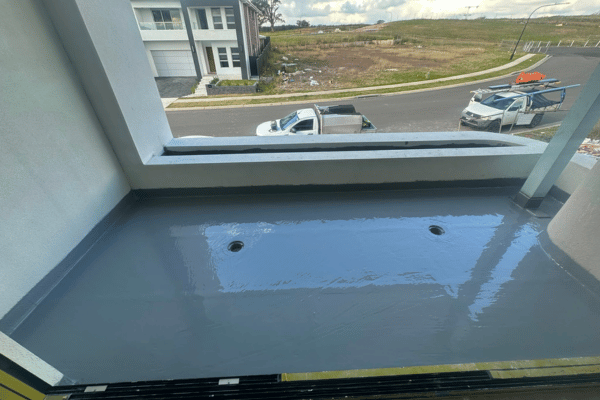
Location: Rouse Hill, Sydney NSW
Project type: Residential waterproofing
Service: Balcony/external waterproofing
Hills Waterproofing has completed residential waterproofing projects in Rouse Hill and throughout Sydney’s Hills District.
Projects involving external waterproofing demonstrate why investigation and preparation are important before membrane application or remedial work begins.
Critical areas can include drainage locations, perimeter junctions, penetrations and transitions between external and internal building areas.
What This Project Shows
The main open floor area isn’t necessarily the most complicated part of balcony waterproofing.
Edges, drains, thresholds and penetrations can require considerably more detailed waterproofing work.
Waterproofing Repairs Across Sydney
Hills Waterproofing provides waterproofing services across the Hills District and wider Sydney, including areas such as:
Whether you’re dealing with a leaking bathroom, balcony, wet area or failed waterproofing membrane, our team can assess the problem and recommend an appropriate solution.
Need Waterproofing Repair in Sydney?
Don’t keep paying for temporary fixes when you don’t know what’s causing the leak.
If you’re seeing mould, dampness, ceiling stains, leaking balconies, bathroom leaks or signs of waterproofing membrane failure, Hills Waterproofing can help investigate the problem.
Request a Waterproofing Repair Quote
Frequently Asked Questions
How do you repair failed waterproofing?
The repair depends on the source and extent of the failure. Some defects may allow localised rectification, while widespread membrane failure may require removal of finishes, substrate preparation and installation of a new waterproofing system.
Can you repair waterproofing without removing tiles?
Sometimes, depending on the actual cause of the leak. However, if the concealed waterproofing membrane itself needs replacement, access beneath the tiles may be necessary.
How much does waterproofing repair cost in Sydney?
Costs vary depending on the size and location of the area, membrane condition, demolition required, substrate repairs, drainage work and reinstatement. A professional assessment is the best way to determine the required scope.
Can you repair only part of a waterproofing membrane?
Local repairs may be possible in some situations, but compatibility with the existing membrane and the condition of the surrounding waterproofing need to be considered.
Why does my waterproofing keep leaking after repair?
Recurring leaks may indicate that the previous work treated the visible symptom rather than the actual source, or that another defect such as drainage, plumbing or membrane failure is present.
Who should I call for waterproofing repairs in Sydney?
A suitably qualified waterproofing professional can assess waterproofing-related problems and recommend appropriate repairs. Hills Waterproofing provides waterproofing repair and installation services throughout Sydney.
📞 Call us at 0410 570 721
📧 Email: [email protected]
Related Services from Hills Waterproofing
CHECK OUR 5⭐ GOOGLE REVIWE
CHECK OUR 5⭐ GOOGLE REVIWE
GET A FREE QUOTATION
GET A FREE QUOTATION
